

CANcrypt Use Cases
The use cases below cover compliance with the EU Cyber Resilience Act and IEC 62443, complete confidentiality through full encryption, zoning that confines protection to the exposed segments and the Secure Heartbeat as an early warning that a device has been forced off the bus. These are the ones worth elaborating, not the whole list: the same protection also guards intellectual property such as recipes or motion sequences and shields personal data where a system handles it.
Meeting the EU CRA and IEC 62443
CANcrypt is a defense-in-depth building block for regulatory
compliance. The EU Cyber Resilience Act and IEC 62443 expect
communication to be authenticated and, where confidentiality
matters, encrypted. CANcrypt delivers that protection at the
link layer, so a product can meet the
authenticated-and-encrypted expectation on the bus without
redesigning its application protocol. It sits alongside the
other controls in a layered security architecture rather than
replacing them. For how these layers compose into a single
strategy, see the CAN Security Reference at:
Defense in Depth for CAN.
Complete Authentication and Encryption
Because CANcrypt can authenticate and, when configured for
full confidentiality, encrypt every addressed data unit a node
sends, it protects all communication rather than a hand-picked
subset of messages. For CAN and CAN FD that makes it the only
option today that delivers complete confidentiality across the
network: every secured frame is unreadable to an observer and
is rejected if it has been altered. Where a system needs
assurance that nothing on the bus can be read or forged, this
is the posture to run. Frame-level authentication and
encryption is one defensive shell among several; the CAN
Security Reference describes this in section:
Frame Security.
Zoning and Segmentation
Not every network needs protection everywhere. When the
requirement is limited to part of the system, CANcrypt can run
on the exposed segments alone. Following the zoning and
segmentation approach of IEC 62443, a designer divides the
network into zones by risk and applies SPsec only where it is
needed, for a example a segment that reaches a diagnostic port
or an external connection, while leaving low-risk internal
segments untouched. A security bridge connects a protected
zone to the rest of the system, which keeps the cost and the
overhead of security proportional to the actual exposure.
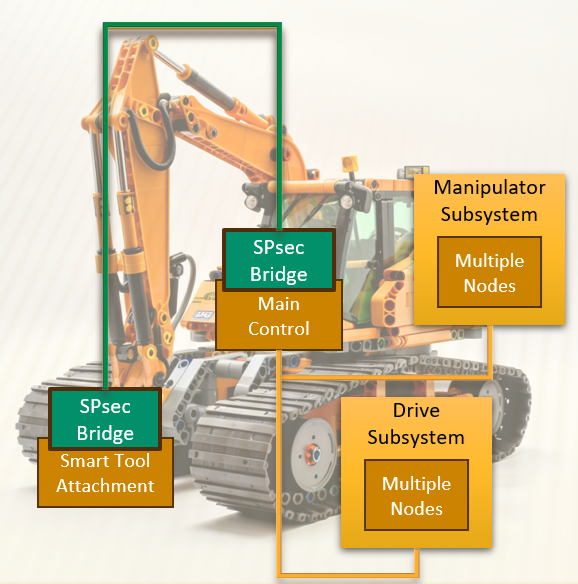
Such an example is shown in the title figure where a
construction machine has an exposed network wiring section
along a beam. As all other sections are protected from
physical access, only the exposed section uses secured
communication. For the system-level method this follows, see
the CAN Security Reference at
Zoning and Segmentation.
Secure Heartbeat as a Breach Indicator
Some attacks happen below the protocol, at the physical or
link level: rather than forging a message, an attacker forces
a single device off the bus, for example by cutting its
connection or overwhelming it. CANcrypt makes that visible.
Every participant in the secure state publishes an
authenticated Secure Heartbeat on a fixed cycle, so if a unit
is knocked off the bus its heartbeat stops arriving, and that
missing heartbeat is the first indication of an attack. The
sublayer reports it as a security event to the host
application, so a drop-off that would otherwise look like a
loose connection becomes a signal worth acting on. Treating a
lost heartbeat as a monitored security event fits the approach
described on the CAN Security Reference at
Anomaly and Event Monitoring.
Frequently Asked Questions
Does CANcrypt help meet the EU Cyber Resilience Act?
Yes. CANcrypt authenticates and, where configured, encrypts communication at the link layer, which is the authenticated-and-encrypted protection the EU Cyber Resilience Act and IEC 62443 expect for data in motion. It is one defense-in-depth layer within a wider security architecture.
Can CANcrypt protect only part of a network?
Yes. Following zoning and segmentation, you can run SPsec only on the exposed segments and connect them to the rest of the system through a security bridge, keeping the overhead proportional to the actual risk.